Angel Investor Simulator: The Serbian Tycoon Game Where Wacky Startups Hide a Real Economy
A sarcasm detector wants your money. Bigosaur's Milan Babuškov explains why the jokes sit on top of a carefully tuned economic model.
Most tycoon games ask you to build something. Angel Investor Simulator asks you to judge something, usually under pressure, and usually while other investors are trying to take the deal away from you.
On the surface, the game is a joke machine. Founders walk in pitching products like a sarcasm detector, and rival angels sit beside you waiting to outbid you for equity. Underneath, its developer promises a realistic economic simulation, in which pricing, quality, marketing, sales and support all shape a company’s share of the market. That contrast is the game’s central hook, and it says a lot about the person who built it.
Angel Investor Simulator is the latest release from Bigosaur, the small Serbian studio led by Milan Babuškov, whose previous games include Son of a Witch, Crypto Miner Tycoon Simulator and Clutchtime. Babuškov also holds a master’s degree in economics. We spoke with him in October, ahead of the game’s November 17 launch on Steam, about building a real economy under a comedy premise.
Developer Spotlight
- Developer: Bigosaur (Milan Babuškov)
- Publishers: Gamersky Games and GAMIKE (per Steam)
- Location: Serbia
- Release: Out now on Steam (released November 17, 2026)
- Price: $11.99; $9.59 with a 20% launch discount at the time of writing
- Platforms: Windows (Steam). The developer says it is tested on Linux and Steam Deck via Proton. The official press kit also lists a Nintendo Switch version in the same release window, which is not yet confirmed on a store page.
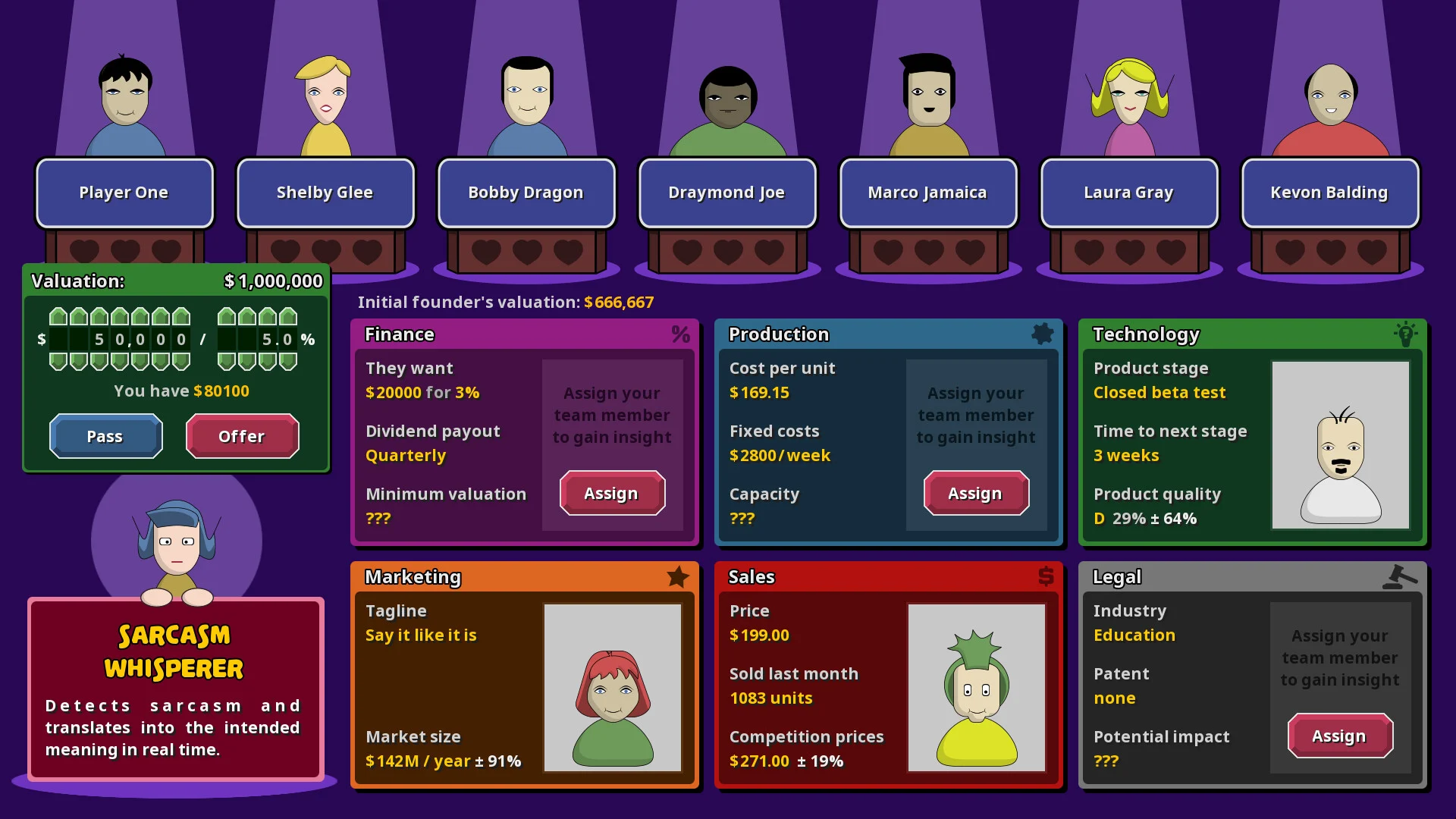
What Is Angel Investor Simulator?
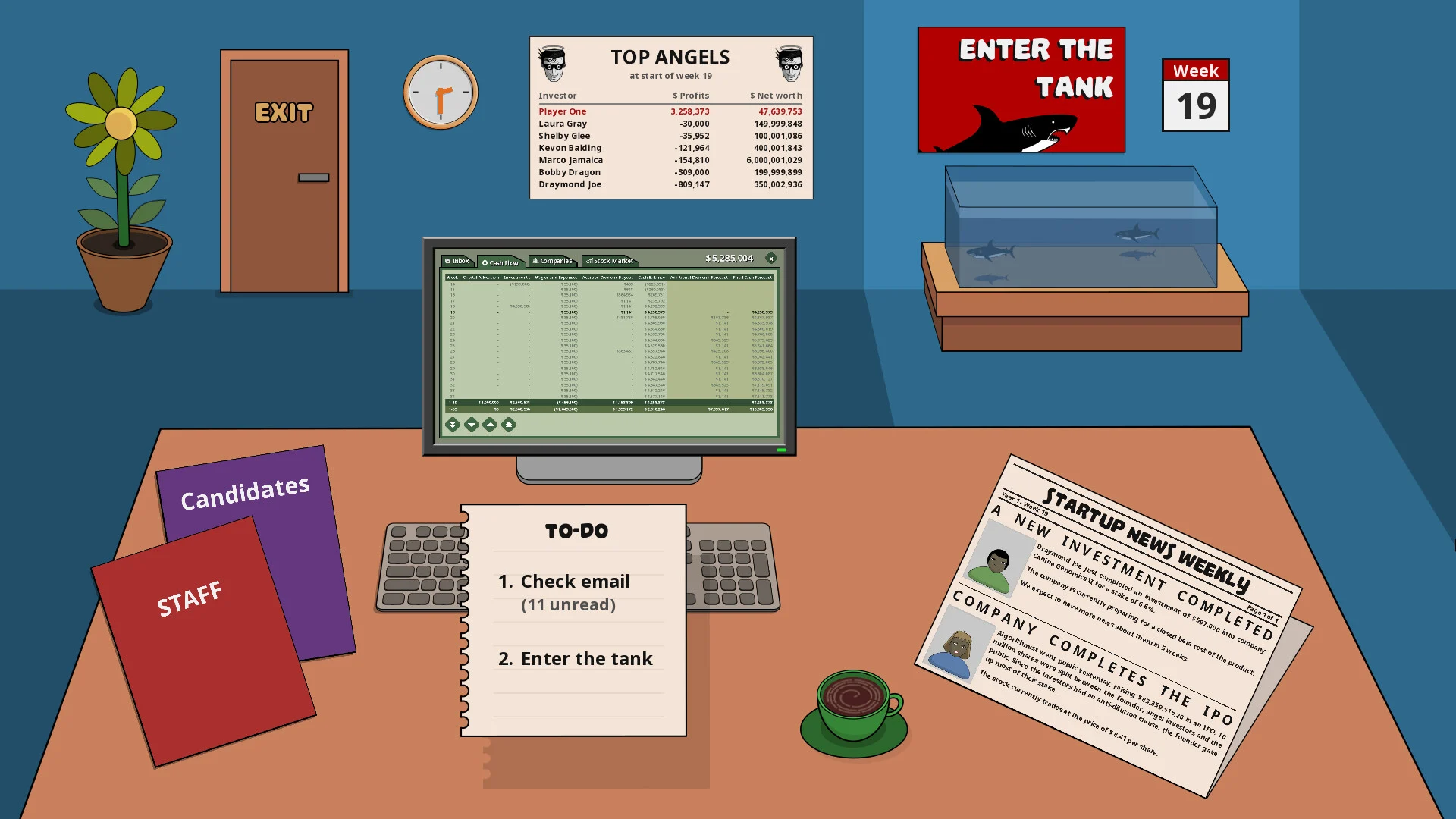
According to the Steam page, Angel Investor Simulator is inspired by a famous TV show and Silicon Valley startup culture. Players compete with other angels to invest in the most promising startups and climb the rankings. Each startup has starting parameters, which the player can improve by assigning advisors from their own team of experts, with the goal of helping the company reach product-market fit.
The Steam page lists the core loop in detail:
- Bidding: compete in a bidding war against other angels for a stake in new companies.
- Due diligence: use your experts to research a startup before investing.
- Management: assign employees to help startups grow, manage wages and expenses, help them apply for patents and vote on important business decisions.
- Pricing: adjust product prices against the competition.
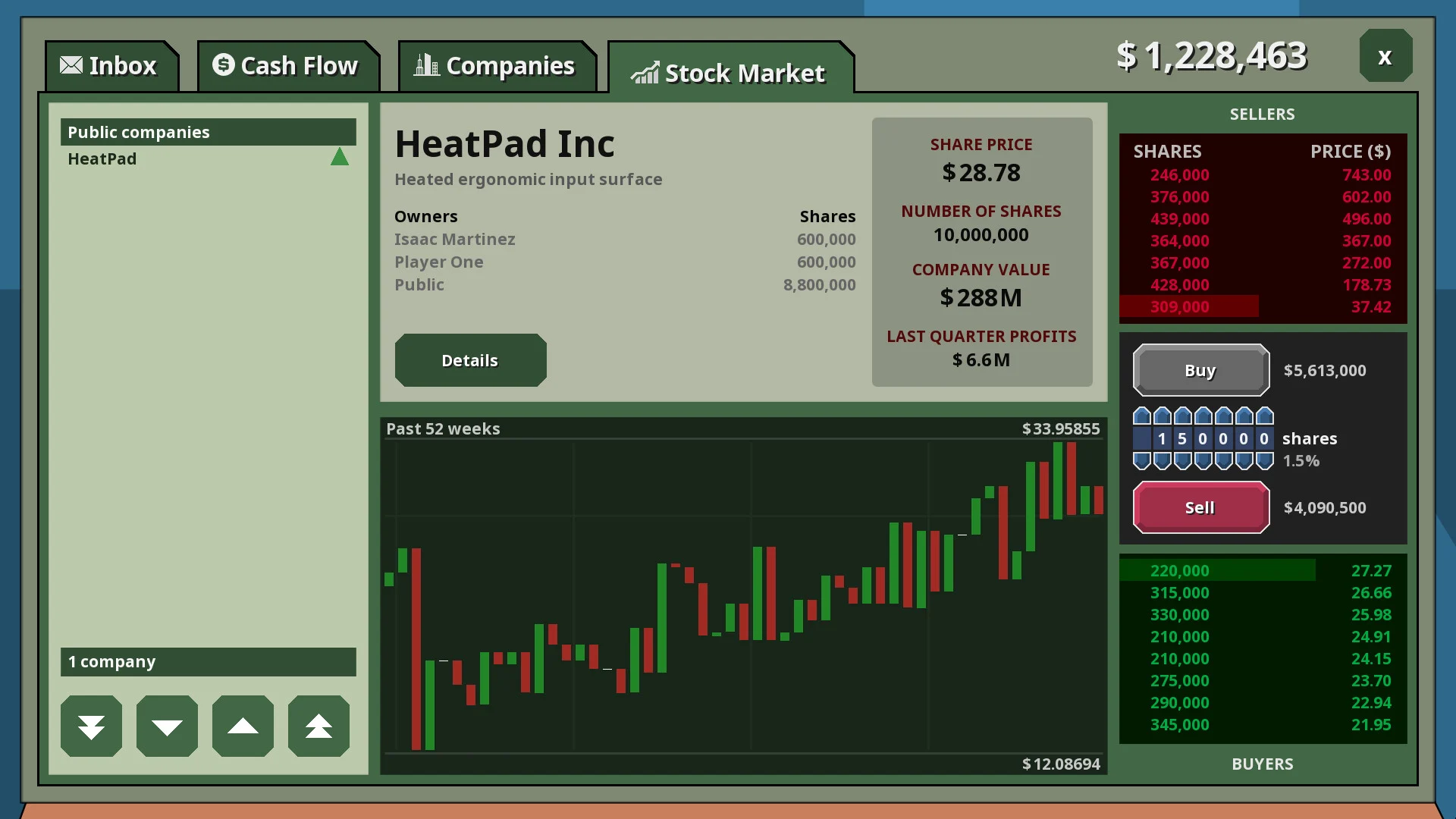
- Exit: trade on the stock exchange after a company completes its IPO.
The game ships with three scenarios of different difficulty and a Sandbox mode. The official press kit names them as VC Internship, Bank Loan and Shark Loan, the last of which starts the player at 300% interest. Steam lists 29 supported languages, Steam Workshop support and full controller support.
The Interview
Iron Bridge Games: The game is inspired by a famous TV show and Silicon Valley culture. How do you balance the wacky startup ideas with a realistic economy underneath?
Milan Babuškov: Initially the game had actual serious product ideas, but playtesters said it was somewhat mundane, so I replaced them with funny ones. You can still find some genius ideas in there, but also some silly stuff. When you see a weird product idea, you can simply decide not to invest, or you can check financial parameters and decide.
I think this works in reality as well. Often the investors start to roll their eyes when they hear the idea, but they get very interested when they learn it has big sales and is making money.
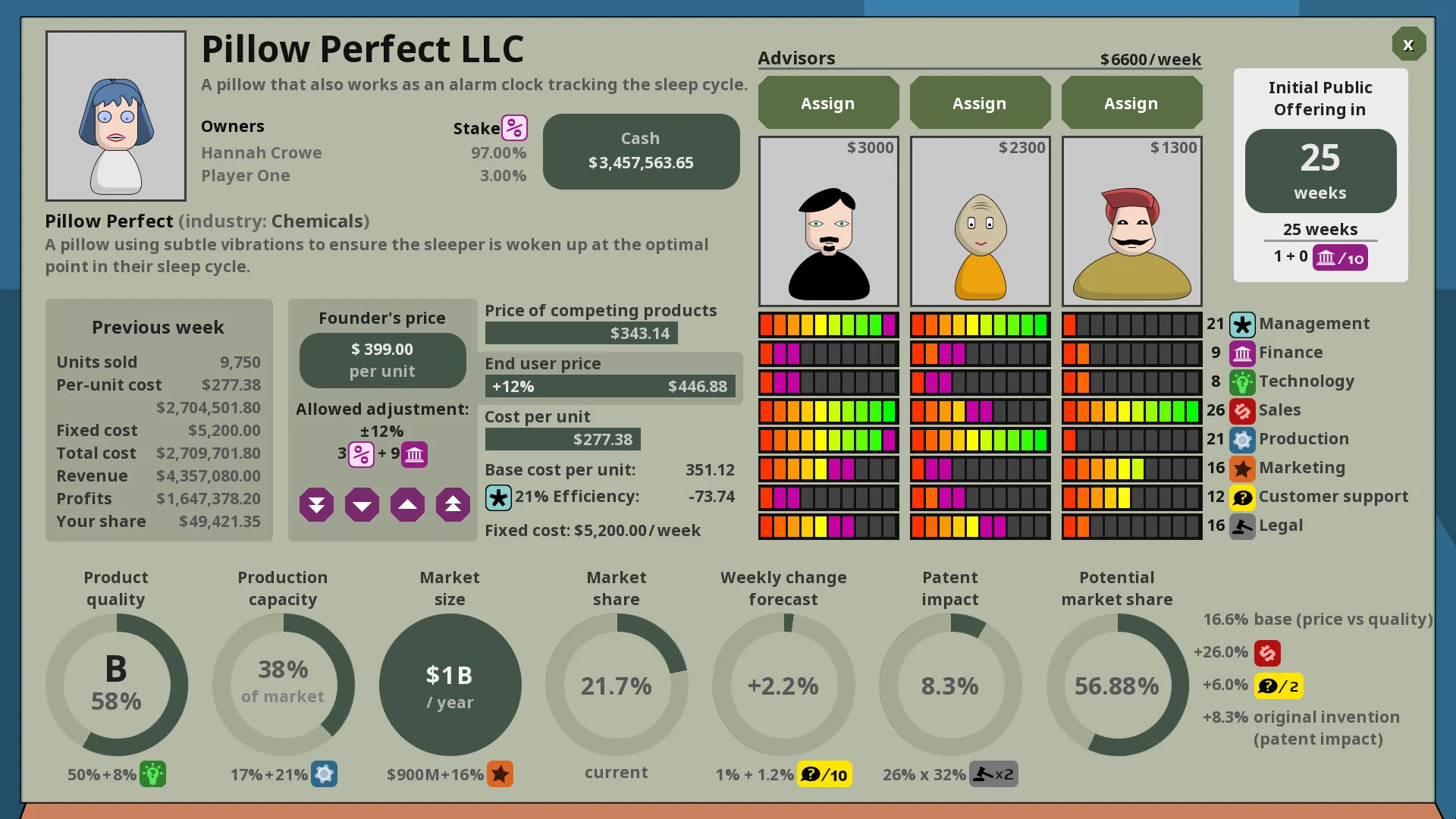
Iron Bridge Games: Market share depends on quality, pricing, marketing, sales and support. Which of those was hardest to model, and why?
Milan Babuškov: The price/demand curve was a very delicate thing, and it took a lot of time to do right, because it has other factors like product quality that change it. Selling a high-quality product at higher-than-average prices can still make you a dominant player in the market (see the iPhone, for example).
Iron Bridge Games: After Crypto Miner Tycoon Simulator and Clutchtime, what keeps pulling you back to economic and management games?
Milan Babuškov: I wanted to play to my strength, which is making games with complex systems underneath. It’s something that not every studio can replicate, so I can make pretty unique games that stand out that way, even though some of those are for niche audiences. Also, I have a master’s degree in economics, so I’m drawn to the subject naturally.
Iron Bridge Games: How did the partnership with Gamersky Games and GAMIKE come about, and what does a Chinese publisher bring to a Serbian indie game?
Milan Babuškov: Publishers are mostly for localization and marketing support. Developing the game takes a lot of time and energy, so I often cannot focus on too many things myself.
Iron Bridge Games: What have you learned from the Next Fest demo so far, and what will change before launch?
Milan Babuškov: There are some quality-of-life features that need to be added. The main work won’t be anything from the demo. The full game is still missing a lot of content; some of it is just removed from the demo, and some other things are yet to be created. The demo is just the tip of the iceberg. Other game modes will have complex branching stories, various events and ways to spend your wealth.
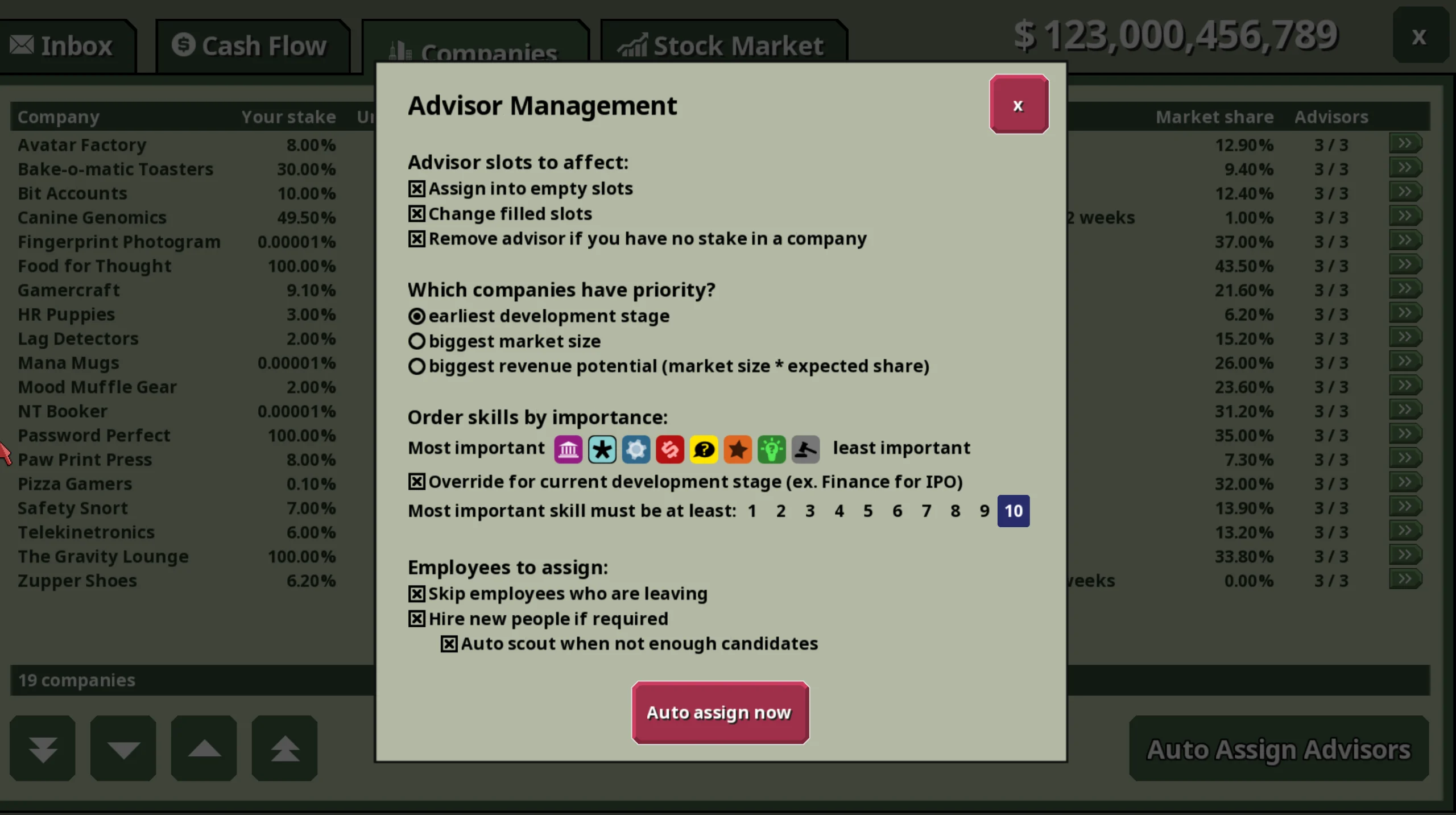
Babuškov also shared an exclusive first look at a then-unannounced feature that lets players automatically assign advisors to the startups in their portfolio.
Iron Bridge Games: You have been making games in Serbia since 2013. How has the local scene changed since then, and what is it like to run a small studio there today?
Milan Babuškov: I don’t think much has changed for me personally, but it’s nice to see growth of the local scene. There are many new studios starting their projects, and it’s nice to see teams forming, not just a single developer. If you want more details, check the recent Serbian Games Week on Steam. I believe the sale page is still available, so you can see all the games.
Why This Matters in 2026
For players, Angel Investor Simulator occupies an underserved corner of the management genre. Most tycoon games are about production: building the factory, the theme park or the railway. This one is about allocation, deciding where capital goes and then living with the consequences through pricing, board votes and an eventual IPO. Babuškov’s own description of the design, comedy on top and a carefully tuned price and demand curve underneath, is the clearest summary of what the game is reaching for.
For developers and publishers, the more interesting point is the business model around it. A one-person-led Serbian studio is launching on Steam with 29 languages and two publishing partners listed on its store page, and Babuškov is direct about why: localization and marketing support free him to spend his time on development. The official press kit describes the game as self-published with Gamersky Games as a regional partner for South East Asia, while Steam lists both Gamersky Games and GAMIKE as publishers. Either way, it is a practical case study in how small studios from smaller markets are reaching Asian audiences without giving up control of the game itself.
On a broader level, the interview also points to a Serbian scene that is growing in structure, not just in numbers. Babuškov, who has been making games there since 2013, notes that new studios are increasingly forming as teams rather than as single developers. That distinction matters for a region whose indie output has long depended on a few determined individuals.